


A nursing student walks into an exam room, where an actor playing the patient is sitting on the edge of the bed. The ‘p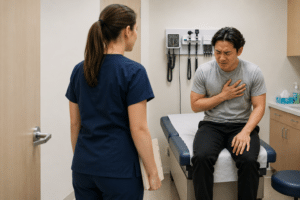 atient’ is clutching their chest, and even though they’re acting, they won’t recite a neat list of symptoms. They’ll say something vague, like ‘it’s a little tight here,’ and point towards their shoulder. The clock is ticking, the instructor is watching, and the student has less than 10 minutes to figure out what’s wrong.
Under all the pressure, the student forgets to ask when the pain started, and they also don’t check the family history of heart problems. They get confused, overwhelmed, and make a good amount of mistakes.
And that’s exactly what you want.
The point of this lab wasn’t to test knowledge or procedures.
| Acute stress results in impaired working memory and poorer decision-making; both skills required in clinical high-pressure environments. – National Institutes of Health |
Most mistakes happen because the person freezes up, not because they lack knowledge, and these controlled environments exist to train students how to stay calm and ask the right questions.
Why Classrooms Alone Aren’t Enough
Students can’t learn without a lecture hall, but as safe and as useful as that environment is, it’s also fake.
A student will read a textbook and learn that a heart attack usually comes with chest pain, but it doesn’t tell what to do when the patient points to their jaw instead of their chest. Real people are messy, and they often forget important details or leave something out because they think it doesn’t matter.
So, if a student has only a textbook as their source of information, they won’t get very far.
This is why we need simulation labs.
| Sim-based medical education is closely linked with improved clinical skills and patient care when compared to traditional education methods. – National Institutes of Health |
They create real pressure, so when you’re working in it, with a limited amount of time, you’ll make mistakes. And then you’ll learn from them. The actors who play patients are trained to respond in a consistent manner, so instructors can compare how each student did in a given situation.
The goal here isn’t to memorize a bunch of data, but to react well under pressure.
And that’s not easy to do.
However, the risk is simply too high, and misdiagnosing someone isn’t a small thing. In Illinois, for example, a single misdiagnosed case can turn into malpractice if the patient can prove that a medical professional made a mistake and harmed them.
Unlike Texas or California, there’s no cap on non-economic damages (like pain and suffering) in Illinois, so a Chicago misdiagnosis lawyer might end up working on a case where a provider just forgot to ask the right follow-up questions under pressure.
That failure is the reason why simulation training is so important.
The Moments Where Students Usually Crack
In short, simulation labs are designed to make students look bad.
They exist so they can make as many mistakes as possible and learn how to react to the unpredictability that is the medical field in general. It’s important to note that mistakes aren’t failures, and they don’t mean someone is ‘bad’ at what they want to do.
Mistakes are the whole point of this because they show what needs further practice.
Emergencies That Ruin Communication
Ask a student to name symptoms of a stroke, and they’ll tell you right away. But when the simulation starts, and the actor can’t speak well or move their arm properly, that same student is very likely to freeze or even shout weird instructions to the actor.
They have the knowledge, but their communication skills are nonexistent.
In an actual emergency, communication is everything, and if you miss information during a handoff, you can put the patient in danger.
Fake Patients Expose Real Assumptions
Simulated patients actively try to be nothing like the cases students have seen in their textbooks. A student will expect a person having an allergic reaction to say that their throat is swelling, but an actor will say their throat feels ‘funny.’ The student might hear that and assume something else is the problem, like an infection, and stop investigating further.
Simulated labs also train good listening.
When you can’t truly listen to another person, you rush to a conclusion, and that could end catastrophically.
Students Remember Mistakes More Than Lectures
The mistake you make during training will stick with you a lot longer than a PowerPoint presentation, and educators know it.
| Active experience-based learning (e.g., simulation) is shown to improve retention rate and long-term skill acquisition. – National Training Laboratories |
After a scenario in a simulated lab is done, the instructor will debrief everyone on what happened and what went wrong. Then they’ll repeat the same simulation over and over, and make fewer mistakes as they go along.
Making a mistake, talking it through, and then trying again is how students build confidence.
Conclusion
Actual mistakes that happen in hospitals and clinics rarely happen because someone doesn’t have the knowledge to handle a case.
They happen because pressure changes EVERYTHING, from how you think to how you listen and speak. So, when a student cracks during a stressful simulation, they should also be relieved. It’s better to crack in training than in the emergency room.
Can simulated patients prevent all mistakes? No. Nothing can.
But they’re definitely a huge help in preventing many of them.